
Most veterans have heard that VA has to give them the benefit of the doubt. Fewer know what the phrase covers, because it is a rule about one specific situation. A tie.
When the evidence for and against a claim is in approximate balance, the doubt goes to the claimant. When it is not in balance, the rule does not apply. The work in a claim is mostly about getting the evidence to that point and recognizing when VA decided it was not there.
What the statute says
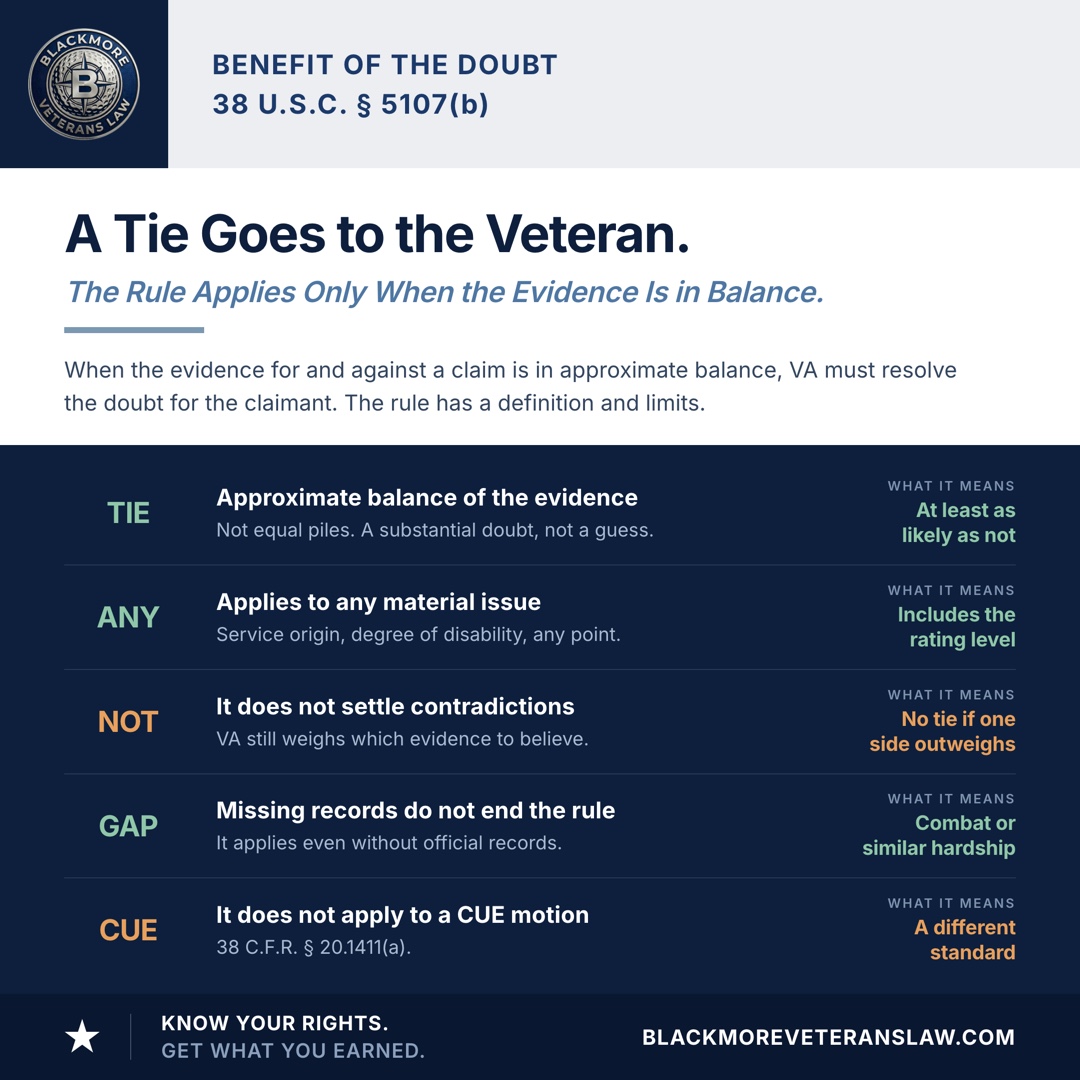
38 U.S.C. § 5107(b) has two sentences. VA “shall consider all information and lay and medical evidence of record in a case.” And “when there is an approximate balance of positive and negative evidence regarding any issue material to the determination of a matter, the Secretary shall give the benefit of the doubt to the claimant.”
The word is shall. It covers any issue material to the claim, which means every element: the current disability, what happened in service, the link between them, and the level of the rating. 38 C.F.R. § 3.102 names “service origin, the degree of disability, or any other point.”
For ratings there are two companion provisions. Section 4.3 says a reasonable doubt about the degree of disability is resolved in the claimant’s favor. Section 4.7 says where there is a question as to which of two evaluations applies, the higher is assigned if the disability picture more nearly approximates its criteria.
What counts as a tie
Section 3.102 defines it. A reasonable doubt is “one which exists because of an approximate balance of positive and negative evidence which does not satisfactorily prove or disprove the claim.” It is “a substantial doubt and one within the range of probability as distinguished from pure speculation or remote possibility.”
VA’s manual puts the standard in plain terms (M21-1, Part V, Subpart ii, 1.A.1.j). The evidence provided by or on behalf of the claimant “must only persuade the decision maker that each factual matter is at least as likely as not.” That is the same threshold used in medical opinions, covered in The Exam Is the Appointment. The Opinion Is What Decides the Claim.
Two things follow from that definition.
It is not a head count. The manual notes that an equipoise decision is “necessarily more qualitative than quantitative,” and that equal weight is not given to each item in the record, because items of evidence do not all have the same probative value. Two thin letters do not outweigh one reasoned medical opinion, and a detailed, credible statement can carry more weight than a conclusory one.
It does not require certainty. The claimant does not have to prove the claim beyond doubt. The doubt has to be substantial, and the rule resolves it in the claimant’s favor.
What the rule does not do
It does not settle contradictions. Section 3.102 says the doctrine “is not a means of reconciling actual conflict or a contradiction in the evidence.” VA still has to decide what is credible and what has probative value. The rule applies after that weighing, if what remains is a balance.
It does not apply when one side clearly outweighs the other. If the evidence clearly favors the claim, it is granted on the merits. If it clearly weighs against the claim, there is no tie to break.
It does not replace the claimant’s responsibility. Section 5107(a) says a claimant has the responsibility to present and support a claim.
It does not apply everywhere. Under 38 C.F.R. § 20.1411(a), it does not apply to the Board’s decision on a motion for clear and unmistakable error in a prior Board decision. How that standard works is covered in Clear and Unmistakable Error.
What it does that people miss
Suspicion is not a reason to withhold it. Section 3.102 says “mere suspicion or doubt as to the truth of any statements submitted,” as distinguished from impeachment or contradiction by evidence or known facts, is not a justifiable basis for denying the doctrine if the entire record otherwise warrants invoking it.
Missing records do not end it. The doctrine “is also applicable even in the absence of official records, particularly if the basic incident allegedly arose under combat, or similarly strenuous conditions, and is consistent with the probable results of such known hardships.” A silent service record is not the end of a claim, which is covered in “I Never Went to Sick Call.” That Doesn’t End Your Claim.
It reaches the rating level. A condition that sits between two levels is a question the rule and § 4.7 were written for.
Where ties come from
Three patterns come up most.
Two opinions at similar probative value. A private medical opinion supports the claim and a VA examiner’s opinion does not. If both are reasoned and based on the record, VA has to weigh them, and the result can be a balance. An opinion that rests on an incomplete record or does not explain itself carries less weight, which is why the adequacy of each matters.
Lay evidence against a thin record. Statements from a veteran, family, or fellow service members, describing symptoms and events they saw or experienced, can offset a record with gaps. A silent record does not by itself prove that something did not happen.
A rating between two levels. The symptoms and findings fit parts of two sets of criteria. That is the situation §§ 4.3 and 4.7 address.
Reading a decision that says the rule did not apply
A decision that denies a claim will often say the preponderance of the evidence is against it and that the benefit of the doubt doctrine is not applicable. That sentence is a conclusion. It should rest on a weighing of the evidence, and the decision has to summarize the evidence it considered and identify the elements not satisfied (38 U.S.C. § 5104(b)).
Read the decision for these:
- Does it cite the evidence that favors the claim, or only the evidence against?
- Does it say why the favorable evidence was outweighed, for example that an opinion lacked a rationale or a statement was contradicted by the records?
- On a rating, does it say why the symptoms fit the lower level and not the higher?
If the decision discusses only one side, you have found something specific to raise.
Which lane
The right route depends on the problem. The full comparison is in How to Appeal a VA Disability Claim Denial.
Higher-Level Review fits when the record already contains the favorable evidence and the problem is how it was weighed. The reviewer works de novo on the same record, cannot take new evidence, and may grant a benefit on a difference of opinion (38 C.F.R. § 3.2601(i) and (j)).
A supplemental claim fits when the file is missing something that would move the balance, such as a reasoned medical opinion or a lay statement. New and relevant evidence can turn a record that weighs against the claim into one that is balanced.
A Board appeal puts the decision in front of a Veterans Law Judge, and the rule applies to the Board’s decisions on the evidence, with the exception above.
In each, file within one year of the decision date to protect the effective date.
What to do with this
- Find the sentence in your decision where VA weighs the evidence. Mark the evidence it cites in favor of the claim and what it cites against.
- Write the evidence for and against on the issue in two columns. Include the opinions, the treatment records, and the statements.
- Ask what would add weight to your side. A treating provider’s opinion in terms of “at least as likely as not,” a lay statement describing what you observed, or a record that is missing.
- If the decision says the doctrine does not apply, check whether it discusses the favorable evidence.
- Match the lane to the problem. Weighing that went wrong on a complete record points one way. A gap in the record points another.
- Count one year from the decision date.
Whether the evidence in any claim is in balance is a judgment about that record. Nobody can tell you your outcome from an article. But the rule is in the statute, VA’s own manual states it as “at least as likely as not,” and a decision that does not engage with the evidence on both sides has not shown how it found there was no tie.
Blackmore Veterans Law, P.C. is a solo practice representing veterans in VA disability claims and appeals. Contact us to discuss your situation.
This article is general information about VA disability law and is not legal advice for any individual case. Reading it does not create an attorney-client relationship. Attorney advertising.