
A military retiree gets a rating decision granting VA compensation. The first VA payment arrives. The next retired pay statement is smaller by roughly the same amount.
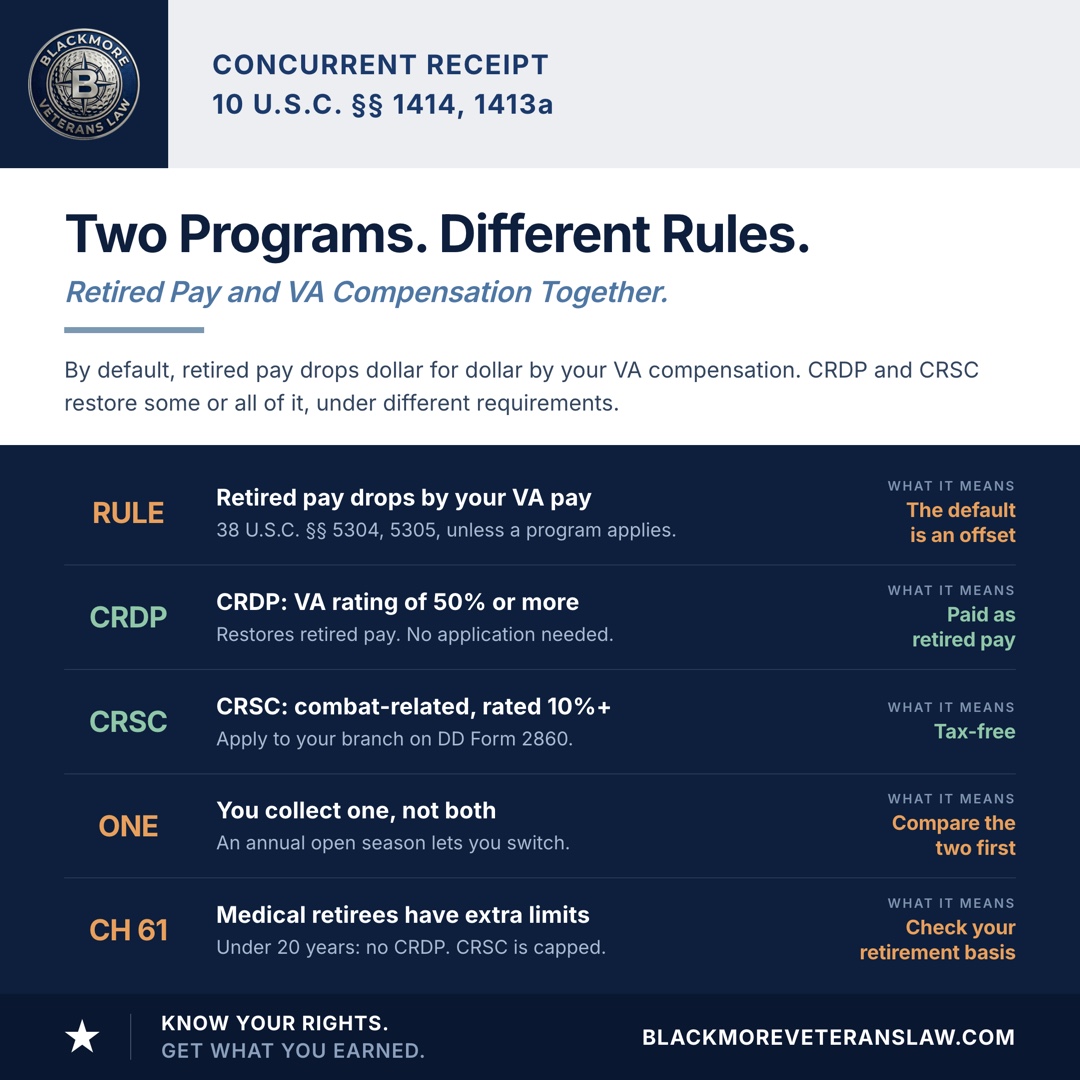
That is the default rule, and it is the law. 38 U.S.C. § 5304(a) bars paying retired pay and VA compensation concurrently. Section 5305 lets a retiree receive compensation by waiving retired pay equal to it. DFAS calls this the VA waiver, or the VA offset.
Congress created two exceptions. They have different requirements, they pay differently, and one of them does not start unless the retiree applies.
The default: a dollar-for-dollar waiver
VA treats a retiree’s application for compensation as the waiver. 38 C.F.R. § 3.750(c)(3) says so in terms: VA will treat as a waiver an application for VA compensation filed by a veteran who is entitled to military retired pay. The retiree does not sign a separate form to start it. Filing the claim does.
A retiree can reelect between the two benefits at any time with a written, signed statement (§ 3.750(d)(1)).
CRDP: automatic, but only at 50 percent
Concurrent Retirement and Disability Pay comes from 10 U.S.C. § 1414. A retiree who is entitled to retired pay and to VA compensation for a qualifying service-connected disability is entitled to be paid both. A qualifying disability is one, or a combination of disabilities, that VA rates as not less than 50 percent disabling.
Congress phased this in from 2004 through 2013. Since January 1, 2014, a retiree who meets the requirements receives retired pay in full along with VA compensation, according to DFAS.
There is no application. DFAS says that because VA shares compensation information with it, it can in most circumstances pay CRDP without a written claim from the retiree. A retiree who believes they are entitled and is not being paid can submit a claim on DD Form 827 to DFAS.
CRDP restores retired pay, so it is paid, and taxed, as retired pay. A Congressional Research Service summary describes CRDP as taxable and CRSC as nontaxable.
Two groups are left out. Retirees rated below 50 percent do not qualify for CRDP, and the waiver stays in place for them. Medical retirees under Chapter 61 have their own rules, covered below.
CRSC: tax-free, combat-related, and you have to ask
Combat-Related Special Compensation comes from 10 U.S.C. § 1413a. It is available to a retiree who has a combat-related disability. The statute defines that as a disability compensable under VA law that is either:
- attributable to an injury for which the member was awarded the Purple Heart, or
- incurred as a direct result of armed conflict, while engaged in hazardous service, in the performance of duty under conditions simulating war, or through an instrumentality of war.
VA’s CRSC page gives examples of each: combat or an occupation or raid; demolition, flying, or parachuting; live-fire practice or hand-to-hand combat training; and exposure to a military vehicle, a weapon, or a chemical agent.
The amount is the VA compensation attributable to the combat-related disabilities, and it may not exceed the reduction in retired pay. A retiree with several service-connected conditions is paid CRSC only on the ones the branch finds combat-related.
CRSC has no 50 percent threshold. DFAS and VA both list a VA rating of at least 10 percent. A retiree with a combat-related condition rated 30 percent can qualify for CRSC and not for CRDP.
CRSC is tax-free according to both VA and DFAS, and the statute provides that CRSC payments are not retired pay.
It does not start by itself. The retiree applies to their branch of service on DD Form 2860, not to VA and not to DFAS, and the branch decides whether the disability is combat-related. VA lists the evidence to include: service medical records from the time of the injury, official service records such as after action reports and investigation reports, award and decoration documents, retirement records, the DD 214, and the VA decision notice.
A VA decision notice is part of that file. VA’s rating decision does not decide whether a condition is combat-related.
You receive one, not both
A retiree who qualifies for both programs receives one or the other. Section 1414(d) says “but not both,” and requires an annual open season in which a retiree can switch.
Which payment is larger depends on the retiree’s retired pay, the VA compensation amount, the share of that compensation that is for combat-related conditions, and how each payment is taxed. DFAS publishes a comparison of the two. A retiree rated 50 percent or more with no combat-related condition has only CRDP to consider. A retiree rated below 50 percent with a combat-related condition has only CRSC.
Medical retirees under Chapter 61
Retirement for disability under Chapter 61 carries its own limits.
Fewer than 20 years of service. The statute says CRDP does not apply (10 U.S.C. § 1414(b)(2)), and 38 C.F.R. § 3.750(b)(3) says the same. The waiver stays.
20 years or more. CRDP applies only up to the amount the retiree would have received had they retired on length of service. DFAS says any remaining disability retired pay is still subject to the waiver.
CRSC. Chapter 61 retirees are not shut out. VA lists medical retirement with a rating of at least 30 percent under Chapter 61 as one basis. But the payment is capped under § 1413a(b)(3), so the combined total cannot exceed what the retiree would have received under another retirement law. The Congressional Research Service summary says the cap can reduce the payment, eliminate it, or have no effect.
Reserve and Guard. For a member retired for disability before reaching retired pay eligibility age, DFAS says concurrent pay may not be paid until that age, and DFAS must receive the retirement information from the branch of service. Contact the branch.
Where the VA rating decision comes in
CRDP and CRSC are administered by the Department of Defense, but the VA decision drives them.
The 50 percent line. A rating decision that brings a retiree’s combined rating to 50 percent is what makes CRDP available. DFAS lists the date a rating first reached 50 percent as one of the limits on retroactive CRDP, which is another place the effective date of a VA grant matters. The rules that move it are covered in The One-Year Lookback and Found Service Records Can Move Your Effective Date.
Every change moves two payments. DFAS tells retirees to expect an increase in VA compensation to be counter-balanced by a decrease in retired pay. A larger waiver may in turn increase CRDP or CRSC. When a VA award is retroactive, DFAS applies debits and credits to the prior months or years, so a retroactive VA payment is not all new money.
Sometimes it ends in a debt. DFAS says it receives more than 15,000 benefit changes from VA each month and that fewer than 2 percent on average result in a debt. A debt letter offers three options: pay in full, set up installments, or have payments deducted from CRDP or CRSC pay. Interest is added beginning 30 days from the date of the notification letter, and a debt delinquent for more than 120 days is transferred to the Department of the Treasury. A related offset, on separation pay, is covered in The VA Can Take Back Your Separation Pay.
A new rating can reopen CRSC. VA’s page says a retiree can ask their branch to reconsider if they receive a new rating for a combat-related condition, or if a rating tied to an existing CRSC award changes.
The deadline for CRSC back pay
VA’s CRSC page states a 6-year statute of limitations. To get the full back payment, the retiree must file within 6 years of any VA rating decision or the date they became entitled to retired pay, whichever comes first. A later filing can recover up to 6 years of payments.
DFAS describes its own limits. A retroactive CRSC payment may go back as far as June 1, 2003, limited by the CRSC start date, Purple Heart eligibility, the retirement date, and the retirement law, and disability retirees with fewer than 20 years are limited to January 1, 2008. Retroactive CRDP may go back as far as January 1, 2004, limited by the retirement date and the date the rating first reached 50 percent.
The two sources describe different limits. Both point the same way: waiting costs back pay.
What to do with this
- Read your retired pay statement. Find the VA waiver and see whether a CRDP or CRSC line appears.
- Check three facts. Your combined VA rating, whether you retired under Chapter 61, and your years of service.
- If you are rated 50 percent or more and no CRDP is being paid, submit a written claim to DFAS on DD Form 827.
- List the conditions that arose in combat, hazardous duty, war simulation, or from an instrument of war, or that trace to a Purple Heart injury. Gather the service records and awards that show it.
- Send DD Form 2860 and copies of the evidence to your branch of service. Keep a copy of everything.
- Compare before you elect. If you qualify for both, ask DFAS for the comparison before choosing, and remember the annual open season.
- After every VA decision, expect your pay to change. Keep the decision notice, since the branch and DFAS may ask for it.
Whether any particular retiree qualifies for either program depends on the retirement type, the VA ratings, and the evidence of how a condition was incurred. Nobody can tell you your outcome from an article. CRDP and CRSC are decided by the military branches and DFAS, and this firm’s practice is VA disability claims and appeals. The VA side, the rating and its effective date, is the part this firm handles.
Blackmore Veterans Law, P.C. is a solo practice representing veterans in VA disability claims and appeals. Contact us to discuss your situation.
This article is general information about VA disability law and is not legal advice for any individual case. Reading it does not create an attorney-client relationship. Attorney advertising.